
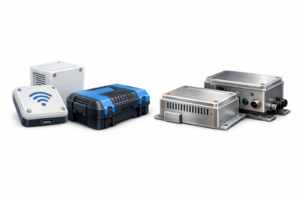
Choosing between plastic vs metal custom enclosures is a key decision in product development across sectors such as electronics, industrial equipment, medical devices, telecommunications, IoT, machinery, additive manufacturing, and outdoor applications.
The material used for an enclosure, housing, or box directly affects durability, cost, thermal behavior, electromagnetic performance, aesthetics, and long-term reliability.
This article offers a clear and practical comparison of this plastic or metal choice, helping designers and manufacturers understand which option best fits their application.
Metal custom enclosures
Metal enclosures are typically manufactured from steel, stainless steel, or aluminum and are widely used in industrial, commercial, and mission-critical applications where robustness is essential.
Advantages of metal
Metal housings provide exceptional mechanical strength, making them ideal for harsh environments and heavy-duty equipment. They also offer effective EMI and RFI shielding, protecting internal components from electromagnetic interference.
In terms of safety and performance, metal box, especially aluminum, deliver good heat dissipation and are non-combustible, improving fire resistance in electrical and industrial systems.
Disadvantages of metal
Compared to plastic, metal housing are heavier and more expensive, increasing transportation and installation costs. They often require additional finishing processes such as painting or coating.
Corrosion can be an issue with carbon steel unless treated, while stainless steel and aluminum improve resistance at a higher cost. Metal housings also block wireless signals, which can be a limitation for connected devices.
Plastic custom enclosures
Plastic enclosures are made from thermoplastics such as ABS, polycarbonate (PC), PVC, PE, PP, HIPS, LLDPE, and HDPE. These materials offer a high degree of versatility and are widely used across industries.
Plastic enclosure manufacturing processes
Rotomolding is ideal for producing hollow, durable, stress-free plastic housings, especially for large or complex shapes. It offers lower tooling costs, uniform wall thickness, and excellent impact resistance, making it suitable for outdoor equipment, industrial covers, and 3D printer enclosures.
Injection molding is best suited for high-volume plastic enclosure boxes that require precision and consistent quality. Although tooling costs are higher, it enables tight tolerances, high-quality finishes, and integrated features such as clips and PCB slots.
Advantages of plastic
Plastic housings are lightweight and cost-effective, reducing transport and installation costs. As non-conductive materials, they provide natural electrical insulation and do not require grounding.
They also offer excellent corrosion and chemical resistance, making them ideal for humid or aggressive environments. From a design perspective, plastic enclosures allow great freedom in shape, color, texture, and branding, while supporting features like snap-fit closures or transparent windows.
You may be interested in how rotational moulding plastic is used in agriculture.
Additionally, plastic is transparent to wireless signals, making it the preferred option for Wi-Fi, Bluetooth, and RF-based devices.
Disadvantages of plastic
Plastic enclosures generally have lower mechanical strength than metal and are less suitable for extreme impacts or vandal-prone environments. They also have thermal limitations, as plastic does not dissipate heat efficiently and may deform under high temperatures.
Some plastics can accumulate static electricity, potentially affecting sensitive components, and they offer limited EMI/RFI shielding unless additional metallized coatings are applied.
Plastic vs metal custom enclosures: Typical applications
| Application | Best Option | Reason |
| Wet, humid or coastal environments | Plastic enclosures | Corrosion- and chemical-resistant |
| Heavy industrial machinery | Metal enclosures | High mechanical strength and durability |
| Outdoor equipment | Plastic enclosures (rotomolded) | Weather-resistant, lightweight, low maintenance |
| Industrial control systems | Metal enclosures | EMI/RFI shielding and fire resistance |
| IoT and connected devices | Plastic enclosures | Transparent to Wi-Fi, Bluetooth, and RF signals |
| High-temperature applications | Metal enclosures (aluminum) | Better heat dissipation |
| Temporary installations | Plastic enclosures | Cost-effective and easy to install |
| Vandal-prone public areas | Metal enclosures | Higher impact and tamper resistance |
| Large or complex housings | Plastic enclosures (rotomolding) | Enables complex, hollow shapes |
Ultimately, selecting the right enclosure material means balancing performance, durability, production volume, and cost. A careful evaluation of how and where the enclosure will be used is essential to ensure long-term reliability and a successful product design.
FAQs: Plastic vs metal enclosures
Is plastic or metal better for outdoor boxes?
Plastic enclosures are usually better outdoors because they resist moisture and corrosion. Metal is preferred only when high heat or strong impacts are expected.
Which enclosure material handles heat better?
Metal enclosures, especially aluminum, dissipate heat more effectively. Plastic is not ideal for high-temperature applications.
Are plastic enclosures suitable for industrial use?
Yes, plastic enclosures work well in industrial settings where corrosion resistance or wireless connectivity is needed. For heavy-duty environments, metal is the better option.
Does production volume influence material choice?
Yes. Plastic enclosures suit medium to high volumes, while metal enclosures are often used for low volumes or frequent design changes.
ABC Rotomoldeo: Custom rotationally molded plastic enclosures
At ABC Rotomoldeo, we specialize in the manufacturing of custom plastic components using rotational molding for companies across multiple industries. We combine modern, state-of-the-art machinery with our greatest asset: a multidisciplinary, highly committed team with strong technical expertise and dedication.
Rotational molding allows us to produce custom-made plastic housings and boxes, including large and geometrically complex parts, tailored to the specific requirements of each project.
Looking for a reliable partner for custom rotomolded plastic parts?
Our team supports you from early design and material selection through to final production.
Contact our team today to discuss your custom enclosure, housing, or box requirements and discover how rotational molding can add value to your next project.