
Why is water storage so important?
Water storage is essential for homes, farms, and industries around the world. Suburban households use water tanks for laundry, garden irrigation, and emergency supplies, while rural farms rely on stored water to sustain crops and livestock.
The right water tank ensures a reliable supply, reduces dependence on mains water, and supports efficient water management for any application.
Different uses for water tanks
Water tanks serve many purposes depending on the environment and user needs. In homes, they support garden irrigation, laundry, and emergency water reserves. In agriculture, they provide a consistent supply for crops and livestock. Industrial facilities rely on tanks for production processes, firefighting systems, and large-scale storage.
They are also integral to water treatment and management, supporting stages such as pre-treatment, primary and secondary treatment, storage, reuse, and pumping.
Water tanks come in various materials, designs, capacities, and installation types, which we explore in the sections below.
What materials are water tanks made of?
The material of a water tank influences durability, maintenance requirements, and cost per litre. Common options include plastic, fiberglass, steel, and concrete, each with unique benefits and considerations.
Plastic water tanks
Plastic tanks are widely used due to their versatility, durability, and ease of installation. They are suitable for domestic water supply, rainwater harvesting, agricultural irrigation, livestock watering, industrial processes, firefighting, and water treatment stages.
Polyethylene is the most common plastic for modern water tanks.
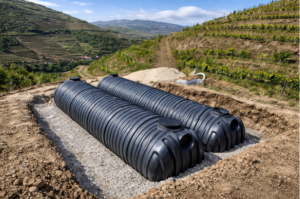
Rotomoulded polyethylene tanks are made through a rotational moulding process that creates a seamless, one-piece tank. This ensures leak-free performance and strong structural integrity. Being food-grade, polyethylene is safe for potable water without additional linings.
Read more about: Water storage rotomolded tanks
These tanks are ideal for domestic, agricultural, and industrial applications, including potable water storage, wastewater management, and process water.
Advantages:
- Lightweight and easy to install.
- Taylor-made options available, allowing custom designs to fit specific size or capacity requirements.
- UV-resistant and durable for outdoor use.
- Cost-effective compared to steel or concrete.
- Suitable for residential, agricultural, and industrial use
Rotomoulded plastic tanks and increasingly preferred for modern rainwater harvesting systems.
Fiberglass tanks
Fiberglass tanks are rigid and lightweight but require a food-grade lining for potable water. They resist corrosion from most chemicals and are more common in industrial settings than domestic applications. While their thin walls are strong, they can crack under stress and cost more than polyethylene. Fiberglass tanks are best suited for specialized industrial water storage.
Steel tanks
Steel tanks are reliable for large-scale water storage in rural and industrial areas. Lined steel tanks are made from bolted panels with protective internal linings, often food-grade plastic or AQUALINER Fresh®. They are fire-resistant, hold large volumes, and are typically constructed from Zincalume® or Colorbond® steel. Stainless steel options resist corrosion without additional linings but are more expensive. Steel tanks are strong and durable, though installation is heavier and more labor-intensive than plastic alternatives.
Concrete tanks
Concrete tanks offer maximum durability and resistance to environmental damage and fire. However, they are heavy, difficult to transport and install, and may affect water pH. Sealing and cleaning are required for potable water, and repairs necessitate emptying the tank.
Concrete tanks are ideal when long-term durability takes priority over convenience.
How do you choose the right water tank?
Selecting the right water tank depends on several key factors:
- Capacity – How much water do you need for household, agricultural, or industrial purposes?
- Available space – Can you install above-ground or do you require underground tanks?
- Intended use – Drinking water, irrigation, firefighting, or industrial processes.
- Material preference – Plastic, steel, fiberglass, or concrete.
- Environmental conditions – UV exposure, bushfire risk, and climate.
- Budget – Cost per litre and installation expenses.
- Maintenance – How easy is it to clean and repair the tank?
For most modern applications, rotomoulded polyethylene tanks provide a versatile solution, balancing durability, cost, and ease of installation.
Why rotomoulded tanks are ideal
Rotomoulded tanks are a preferred choice for rainwater harvesting, domestic water storage, and industrial applications due to several advantages:
- Design flexibility – Can be produced in a variety of shapes and sizes.
- Seamless construction – Reduces leaks and maintenance issues.
- Lightweight and easy to transport – Ideal for large or multiple installations.
- Cost-effective manufacturing – Cheaper than stainless steel or concrete alternatives.
- Sustainable material – Polyethylene is recyclable and environmentally friendly.
Know more about the rotomolding process
These tanks are widely used in residential, agricultural, and industrial sectors, offering reliable water storage for years with minimal maintenance.
For expert advice and high-quality solutions, contact our specialists at ABC Rotomoldeo to help you design and manufacture the perfect water tanks for your needs.