
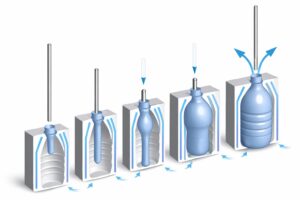
When discussing blow molding, also referred to as blow moulding, we refer to an industrial process used to manufacture hollow plastic parts. In this method, a heated plastic tube called a parison is expanded inside a mold using compressed air, forming precise and uniform pieces.
This technique is widely used for bottles, containers, and industrial tanks. Understanding its advantages and limitations, as well as comparing it with rotomolding, is essential for making informed decisions about your project.
What is blow molding and why it matters
Blow molding allows the production of hollow parts quickly and consistently, making it ideal for high-volume applications. Its strength lies in production speed, wall thickness control, and consistent results.
How the process works
- The thermoplastic material (such as HDPE or PET) is melted and formed into a parison or preform.
- The parison is placed inside the mold.
- Compressed air is used to expand the plastic against the mold walls.
- The piece is cooled and removed for use or secondary processing.
This cycle repeats constantly in industrial production lines, ensuring efficient, uniform blow molded products.
Blow molding vs rotomolding: Key differences
Although both processes produce plastic parts, they operate differently and serve distinct needs.
Production speed
- Blow molding: extremely short cycles, often less than a minute, ideal for high-volume production such as bottles and consumer containers.
- Rotomolding: longer cycles due to slow heating and cooling, limiting production rate per unit of time.
Learn about the step-by-step rotomolding process
Design complexity
- Blow molding: excels for simple hollow shapes with thin walls (bottles, small tanks, and containers).
- Rotomolding: allows more complex geometries and thicker walls, offering greater design flexibility.
The choice depends on the product’s complexity and the design freedom required.
Tooling costs
- Blow molding: uses high-strength steel molds, which involve a higher upfront cost but are cost-effective for mass production.
- Rotomolding: uses simpler, usually aluminum molds, reducing initial cost, but cycles are slower.
You might also be interested in learning about the comparison with the plastic injection molding manufacturing technique.
Comparing blow molding and rotational molding
|
Feature |
Blow Molding | Rotational Molding |
| Design flexibility | Limited | High |
| Shape complexity | Simple | Complex |
| Wall thickness | Thin to moderate | Thick |
| Strength | Moderate | High |
| Part size | Small to medium | Small, medium, large |
| Material form | Pellets | Powder |
| Tooling cost | Higher | Lower |
| Cycle time | Short | Long |
| Production volume | High | Low |
| Cost per part | Lower | Higher |
| Inserts/Graphics | Yes | Yes |
Blow molding is best for high-volume, simple parts, while rotational molding excels at complex shapes and large or customized components.
Discover the comparison with the thermoforming plastic manufacturing technique
Typical use cases
Both blow molding and rotational molding are versatile manufacturing processes, but each has applications where it truly excels. Understanding these use cases can help you decide which technology is best for your project.
Blow molding uses
- Packaging: bottles, jugs, drums
- Automotive: fuel tanks, air ducts, reservoirs
- Consumer & Household: toys, water pitchers, storage boxes
- Industrial: plastic barrels, pipe systems, transport containers
Best for: high-volume, lightweight, hollow parts with consistent quality.
Rotational molding uses
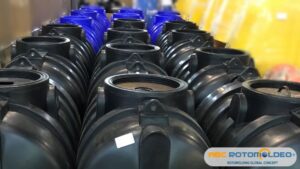
- Storage tanks: water, chemical, and fuel tanks
Know more about rotomoulding in the agricultural sector
- Automotive: air ducts, reservoirs
- Play structures: slides, climbing structures, playhouses
- Watercraft & Sports: kayaks, canoes, buoys
- Construction & Infrastructure: traffic barriers, septic tanks, manhole covers
- Furniture & Design: plastic chairs, tables, planters
Don’t miss our catalog Decoration & Contract
Best for: large, durable, complex-shaped components and low-to-medium volumes.
How to manufacture your components with ABC Rotomoldeo
For projects requiring custom hollow plastic parts or complex geometries, ABC Rotomoldeo is an ideal partner. Specializing in rotational molding, we combine over 15 years of experience with advanced machinery and a dedicated multidisciplinary team.
Why ABC Rotomoldeo?
- Custom sizes and shapes: Parts up to 4.5 meters in diameter.
- Complex geometries: Ideal for hollow or intricate designs.
- High-quality and scalable production: Adaptable to various industries and production volumes.
With ABC Rotomoldeo, you get precision, flexibility, and experience to create durable, high-quality plastic components that other technologies may not achieve. Contact our team.